● Accuracy

Tested against real plan sets, not claimed.

On the one real plan set we have fully verified, Freeport Square (21 pages), 68.9% of walls were auto-matched and 99.8% after one "Confirm all." That is a single data point, not a promise about your plans. No accuracy percentage gets put on this site unless it came from actually running the tool against a real, multi-hundred-page commercial plan set and hand-checking the result — the same standard described on the About page. These are the real numbers from that testing, including the bugs they found and how they were fixed, not just the numbers that look good.

Updated October 2026
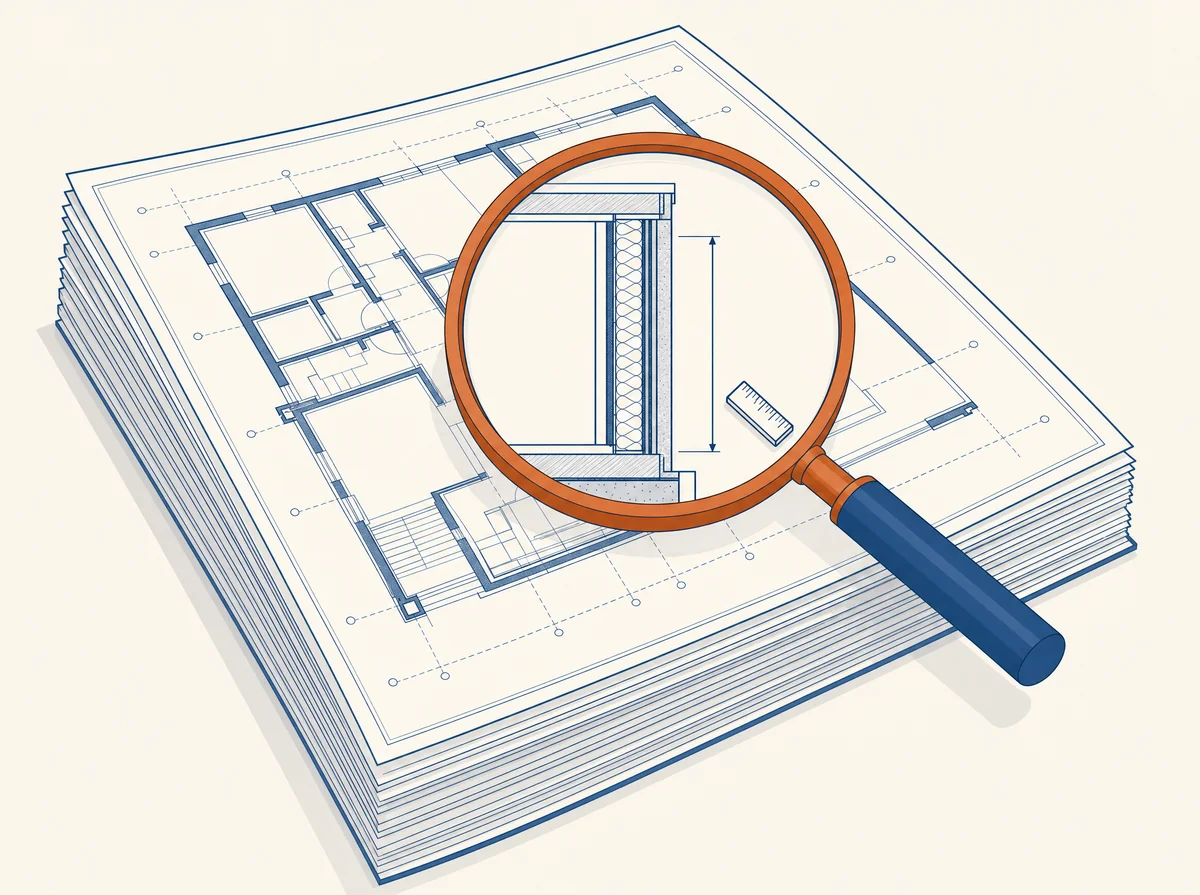
Isometric illustration of a magnifying glass over a stack of real plan sheets, revealing a measured wall detail
Methodology

Real projects, hand-calculated, nothing synthetic.

Every number below comes from running ReadMyBlueprint against actual real-world plan sets — a 103-page water treatment facility, a 165-page school addition and alteration project, and other commercial sets — not a synthetic test file built to make the tool look good. Each result was checked against what a human estimator would measure by hand from the same drawing.

"Coverage" measures how much of a sheet's real, visible geometry the tool actually extracted and could measure — not an accuracy score on its own, but the completeness signal that has to be right before any measurement on that page can be trusted at all.

Real results

What testing against real plan sets actually found.

98.6%
mean geometry coverage
165-page real school addition/alteration set, full document run
98%
of sheets clear the coverage threshold
Same 165-page set — only 4 of 165 pages (2%) flagged, all civil/electrical-site sheets outside this tool's material categories
84%
of real CMU footage confidently matched
127,652 of 152,839 LF — see the before/after below for the bug this fixed
13,700 LF
of framing matched across 3 distinct specs
2 1/2" steel, 3 5/8" 20-ga steel, and 2x6 wood — correctly kept separate, not merged
~200 sec
to read a real 165-page plan set
Full auto-detect pass, every page, on the school addition project
0.125"
tolerance that correctly stayed "ambiguous"
A real 2x4 wood stud and a 3 5/8" steel stud landed within 0.125" of each other — flagged, not guessed
A real bug, and the fix

CMU matching went from 0% to 84% — here's why.

Early testing found that two different real phrasings of the same wall spec on the same project — a direct "8" CMU" callout on one sheet, and a general note reading "ALL CMU TO BE 8" WYTHE" on another — were being treated as two different, conflicting specs instead of one. The result: every wall on that 152,839 LF of real CMU came back "ambiguous" instead of matched, because two contradictory-looking specs existed for the same thickness.

Before the fix
0%
of 152,839 LF of real CMU confidently matched
→
After the fix
84%
matched, with real computed block counts (1.2M+ blocks)

The remaining 16% is genuinely different wall thicknesses with no matching spec found anywhere in the document's own text — correctly left unmatched and flagged for the customer to confirm, rather than guessed at to make the percentage look higher.

What this page won't do

It won't claim a single blended "accuracy %" across every project, every material, forever — that number would hide more than it reveals, since accuracy genuinely varies by how a specific architect drew and labeled their sheets. It won't count an "ambiguous" or "needs confirmation" result as a win just because a number came out. And it won't get updated to look better without the underlying bug fix or test run to back it up — every number above stays tied to the real project it came from.

Try it on your own plan set.

Your first plan set is free — see exactly what it matches, and exactly what it flags for you to confirm.

Get started

Related: Why vector PDFs read better than scans · ReadMyBlueprint vs Togal.AI · Online takeoff software